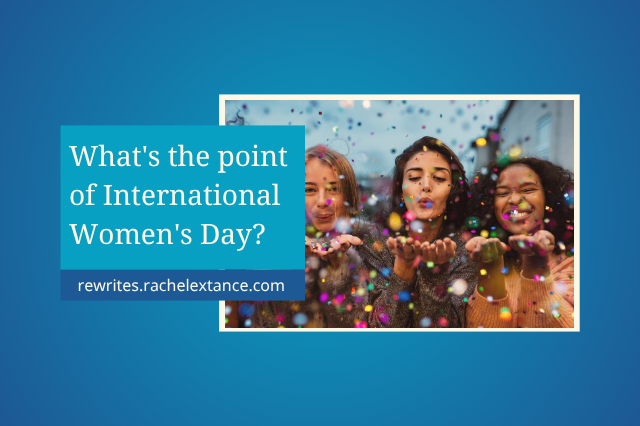
What’s the point of International Women’s Day?
Rights. Justice. Action. For ALL Women and Girls. That’s the theme for today’s International Women’s Day. I’ve debated whether to post about it or not.
Who is this day for?
What’s it adding?
But then I read posts highlighting situations women and girls face every day.
Women who have faced harassment at work.
Girls who get bullied by boys at school.
Requests for nudes.
Being sent unsolicited sexual images.
Sexual comments at work, in the pub, while exercising.
I saw a photo of a woman breaking her fast with her children in a community refuge because they had been bombed out of their home.
I saw another photo of a woman staring at the wreckage of her house.
Meta has created glasses which enable women to be filmed without their knowledge and those images are then catalogued for AI by contractors.
AI contains gender biases. These get baked into decisions, content, and procedures as people adopt AI outputs.
There are so many stats about inequalities women face. For example:
Women have 64% of the legal rights of men.
44% of countries don’t have equal pay legislation.
According to a new UN Gender Report, “legal frameworks directly or indirectly discriminate against women and girls”.
And of course, women are not a single group. We face different challenges and discrimination based on ethnicity, religion, sexuality, gender identity, and nationality.
There are many hard-won rights that are now under threat of being removed, including many women’s ability to vote in the US.
It all feels pretty hopeless.
But today has got many of us, men, women, and nonbinary people, sharing experiences of discrimination, violence, and systemic failures.
One of the words I’ve used in this post could mean it gets suppressed by the algorithm because it’s trained not to promote these much-needed discussions about women’s experiences.
We need to be louder.
And we need to demand better rights, justice, and action for all women and girls.
This is an infographic showing some of the findings from the UN Gender Report.